Fish-men Natural Philosophers
The Blazing WorldThe Fish-men Natural Philosophers combine a specialist role in the Empress’s learned societies with practical knowledge that becomes crucial to her rule beyond the Blazing-World. The Empress summons them to explain what they have observed in the sea and in other waters; later, as Fish-men, they locate a passage between worlds and guide the Empress’s golden ships underwater. Their story links the limits of natural inquiry to the uses of knowledge in imperial action.
Identity and Place in the Learned Societies
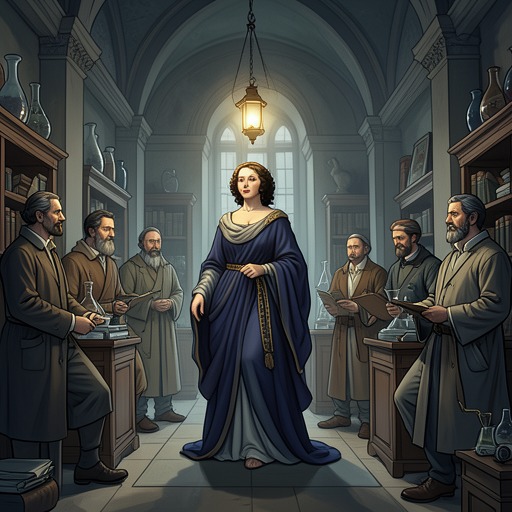
The Fish-men belong to the many species of inhabitants whose professions the Empress organizes according to their nature. She assigns the Fly-men, Worm-men, and Fish-men to natural philosophy, encouraging the subjects who study the arts and sciences and establishing schools and societies for their work. In this arrangement, the Fish-men are not simply objects of natural description: they are observers charged with investigating the world around them and reporting their findings to the sovereign.
The narrative also calls them Mear-men and Syrens. These names refer to the same aquatic people, who can move through water and are described as able to travel between the Blazing-World and the Empress’s native world when a passage is available. Their identity therefore joins a learned office to an embodied capacity for underwater travel, a combination that later turns scientific inquiry into logistical and military service.
Investigations of the Sea and Animal Life
When the Empress calls the Fish-men to account for their observations, she asks what causes the sea’s saltiness and its ebbing and flowing. They attribute both phenomena to volatile salt in the earth around the sea. In their explanation, the sea absorbs this salt and fixes it; the movement they call ebb and flow results from the process of absorption, while portions of the salt that are not readily absorbed strive upward and lift the water. They reject explanations based on the Earth’s motion or the Moon’s influence. The account is presented as the Fish-men’s proposed explanation, not as an uncontested resolution: elsewhere in the narrative, competing observers repeatedly disagree over what natural appearances mean.
The Empress next asks whether all animals living in seas and other waters have blood. The Fish-men answer that some have a little and some none. They report little blood in Crea-fishes and lobsters, and none in crabs, oysters, and cockles. Asked where the blood is found, they describe a vein running along the middle of a lobster’s tail and blood in the back of a Crea-fish. In other kinds of fish, they say, blood may be confined to the gills or found in other limited parts of the body; they have not observed veins spread throughout the body.
The inquiry leads the Empress to ask whether animals without blood can live, since blood is commonly treated as the seat of animal spirits. The Fish-men, joined in this discussion by the Worm-men, answer that blood is not necessary for animal life. What is commonly called animal spirits, they explain, consists instead of bodily motions suited to an animal’s nature and shape. The exchange shifts the account of life away from one supposedly universal bodily substance toward different forms of organization and motion.
Asked whether blood circulates through veins and arteries in every creature that has it, the Fish-men and Worm-men refuse to claim more than their observations support. Circulation is an interior motion, they say, inaccessible to unaided senses and optical instruments alike. Dissection cannot settle the question, because opening an animal alters the internal motions proper to its particular figure. Their answer marks a limit of method: the very act intended to reveal an inner process can change the process under examination.
The Empress also asks whether there are animals intermediate between flesh and fish, and how creatures can live both in water and on land when the two environments seem to demand different forms of respiration. The Fish-men report animals that live in both environments and allow that these may be of a mixed nature, partly flesh and partly fish. They explain that respiration varies among different kinds of creatures: it is a composition and division of parts, and nature’s motions are too various for every animal to depend on air or water in the same way. The Empress appears satisfied with this response, which treats bodily function as species-specific rather than uniform.
Observation, Instruments, and the Limits of Explanation
The Fish-men’s investigations belong to a wider culture of inquiry in which observations do not always settle disputes. In the debate over celestial bodies, the Empress directs the Bear-men, her experimental philosophers, to use Telescopes; these produce conflicting reports rather than agreement. The Empress calls the instruments false informers and favors natural sense and reason, while the Bear-men defend the Telescopes and ask to keep them. She permits their use on condition that disputes remain within their schools and do not disturb the state. The Fish-men’s marine reports are distinct from that telescope controversy, but they take place within the same narrative concern: what can be known from observation, and how confidently an observer may pass from appearance to explanation.
Their account of circulation offers a particularly clear instance of this concern. They distinguish what can be seen from what remains inaccessible, and they identify a practical obstacle to testing a claim: dissection changes the living motions it would be meant to reveal. The narrative thus gives their inquiry both a subject and a boundary. The Fish-men can report veins in particular locations and differences in the presence of blood, but they cannot use those observations to provide a definitive account of circulation.
Passage Between Worlds and Imperial Service
The Fish-men’s knowledge becomes a practical resource when the Empress’s native country is threatened. At the Duchess’s suggestion, the Empress sends the Fish-men to find a passage out of the Blazing-World into the other world. They search in different directions and eventually report that there is a single passage, too small for a vessel larger than a packet boat, and that it is not always open because it can freeze completely. Their report establishes both a route and its constraints, troubling the Empress and the Duchess because the passage may obstruct their plan.
The expedition requires the Fish-men to do more than locate the route. The Duchess advises that they accompany the Empress’s ships underwater, since the golden ships are not equipped to fight with cannons. She expects large numbers of Fish-men to help destroy the enemy fleet before it can approach. The Fish-men are also assigned to carry Fire-stones under water, while Worm-men carry them from the Burning-Mountains for use against the wooden ships of the other world. The contrast is pointed: the Fish-men’s marine expertise serves both inquiry and the movement of an imperial force, while their role in the campaign is planned around the ships’ vulnerability and the limitations of their equipment.
When the expedition sets out, the Fish-men draw the golden ships through the underwater passage with golden chains. The vessels need no sails there; they must instead keep water out and provide enough air for the land animals aboard. Once the ships have passed the Icy Sea, they rise above water and continue toward the Empress’s native country. The Fish-men’s ability to move the vessels through the passage turns their earlier reconnaissance into an indispensable part of the journey.
Their organization therefore has two connected faces. As natural philosophers, the Fish-men offer explanations grounded in observation while acknowledging where observation fails; as aquatic subjects of the Empress, they provide the movement and intelligence on which her expedition depends. The narrative does not separate learning from government: the same specialized knowledge that helps describe the natural world also enables the sovereign’s reach across its boundaries.